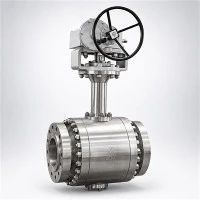




Shandong Yuhong Valve Co., Ltd. is one of the most reliable manufacturers and suppliers of eccentric half ball valve in China. We have world-leading production equipment and strong manufacturing capabilities. Welcome to wholesale bulk high-grade eccentric half ball valve from our factory.
Product Introduction
The Yuhong eccentric half ball valve uses an eccentric rotating half-ball closure. The sealing face lifts away from the seat as the valve opens, which cuts continuous rubbing. Metal hard sealing, wear-resistant trim and pneumatic or electric actuators are available for slurry, industrial wastewater, paper stock and particle-laden lines.
Product Overview
An eccentric half ball valve is an industrial valve that opens and closes by rotating an eccentrically mounted half-ball or spherical cap closure. It is mainly used in systems that need shutoff, wear resistance and moderate anti-clogging performance at the same time.
A standard ball valve turns its ball around its own center. An eccentric half ball valve works differently. The eccentric axis and the special spherical cap shape make the closure move away from the seat sealing face step by step during opening.
This design reduces continuous rubbing over part of the stroke, which helps lower sealing face wear under specific operating conditions.
For slurry, industrial wastewater, paper stock and other suitable particle-laden media, the valve can be configured with metal sealing, a wear-resistant half ball and special flow passages.
Some eccentric half ball valves also have a special cutting edge or anti-settling geometry. These help handle a certain amount of fiber and deposits.
An eccentric half ball valve does not mean any large-particle, high-solids medium will pass through it. Whether it fits depends on particle size, concentration, flow velocity and closing differential pressure.
Shandong Yuhong Valve Co., Ltd. can configure the half-ball structure, seat material and actuator to match the medium, the flow rate and the wear requirement.
Core Advantages of the Eccentric Half Ball Valve
1. Eccentric opening and closing reduces seat friction
The eccentric rotary structure makes the plug lift off the seat during opening, so the sealing faces do not stay in contact through every operating angle.
This cuts unnecessary friction and wear, which suits industrial duties that require frequent opening and closing.
2. Wear-resistant plug and seat
Depending on particle hardness and erosion conditions, the valve can be supplied with STL overlay, tungsten carbide coating or other suitable wear-resistant materials.
For highly abrasive media, consider sealing face hardness, toughness and the base material together to prevent local spalling or cracking.


3. Generous room for the flow passage
The eccentric half-ball design allows a relatively open flow path, which helps particle-laden and fibrous media pass through.
For high-solids or settling media, still check the valve cavity, the seat and the outlet velocity to avoid spots where material builds up.
4. Automation-ready
The valve can be fitted with pneumatic, electric or suitable hydraulic actuators for remote shutoff in the plant.
Size the actuator torque from the maximum closing differential pressure, the sealing contact force and the deposit conditions. Do not pick it from the valve size alone.
Technical Specifications
|
Item |
Parameter and available options |
|
Product structure |
Eccentric rotating half ball / spherical cap |
|
Nominal size |
DN40–DN1200 (NPS 1 1/2–48); special large structures on request |
|
Nominal pressure |
PN10, 16, 25, 40, 63; PN100 can be evaluated for special high-pressure structures |
|
ASME pressure class |
Class 150, 300, 600, depending on structure |
|
Working temperature |
Normally -29℃ to +200℃; metal-seated high-temperature structures up to +425℃ |
|
Body style |
Flanged, side entry, top entry and suitable heavy-duty structures |
|
Body material |
WCB, WCC, CF8, CF8M, CF3M, suitable wear-resistant cast steel |
|
Special body material |
2205, 2507, Monel, Hastelloy and suitable alloys |
|
Half-ball material |
304, 316, 316L, wear-resistant alloy steel and dedicated hard alloy structures |
|
Stem material |
316, 410, 17-4PH and similar |
|
Eccentric structure |
Single offset, double offset or a dedicated eccentric axis design |
|
Seat material |
316, 410, STL overlay and suitable wear-resistant materials |
|
Sealing type |
Metal seal, suitable soft seal, resilient metal seal |
|
Surface hardening |
STL, WC, CrC and suitable surface treatments |
|
Flow passage |
Half-ball bore, dedicated anti-settling structure |
|
Sealing direction |
Uni-directional or bi-directional, verified against the specific structure |
|
Closing leakage |
API 598, ISO 5208 and the leakage class specified by the project |
|
Suitable media |
Industrial wastewater, paper stock, suitable slurry and particle-laden liquids |
|
Travel angle |
90° and suitable dedicated rotary angles |
|
Stem packing |
PTFE, flexible graphite, low-emission packing |
|
Connection |
RF flange, BW and special connections |
|
Flange standard |
ASME B16.5, EN 1092-1, HG/T 20592 |
|
Face-to-face |
According to the product structure and project standard |
|
Operation |
Gear operator, pneumatic, electric, hydraulic |
|
Actuator |
Quarter-turn pneumatic, electric and hydraulic actuators |
|
Control and feedback |
On/off signal, position indicator, remote feedback |
|
Protection class |
IP65, IP66, IP67; IP68 available on special configurations |
|
Optional accessories |
Solenoid valve, limit switch, position feedback, wear-resistant trim |
|
Design standard |
ASME B16.34 and applicable valve design codes |
|
Test standard |
API 598, ISO 5208 and project test requirements |
Note: the sealing principle and trim structure of an eccentric half ball valve differ from those of a full-ball valve. Leakage class, allowable differential pressure and operating torque must be confirmed against the specific product design.
Typical Applications
Mining and ore dressing:
Shutoff of slurry and process liquids at suitable concentration and particle size.
Paper industry:
Paper stock, white water and fibrous medium lines.
Industrial wastewater:
Industrial effluent systems carrying a certain amount of suspended solids.
Metallurgy:
Industrial medium transport lines where material and wear resistance meet the duty.
How Should an Eccentric Half Ball Valve Be Selected?
Analyze particle size and solids content
Solids in the medium drive seat wear, cavity settling and operating torque.
For large particles or high solids content, evaluate the flow passage, the materials and the allowable differential pressure against the actual medium.
Calculate the torque during closing
The eccentric design reduces seat friction over part of the travel, but the final closing stage still has to build enough sealing contact force.
The actuator must therefore cover the actual maximum closing torque, with deposit buildup and sealing face wear taken into account.
Separate shutoff from control duty
A standard eccentric half ball valve is built for on/off shutoff.
If continuous flow control is required, confirm the flow characteristic of the spherical cap profile against valve opening. Do not treat an on/off product as a precision control valve.
Yuhong Manufacturing and Wear-Resistant Design
Key manufacturing items for an eccentric half ball valve include the eccentric axis, the half-ball sealing profile, seat machining and the bearing areas.
Production must control the relative position of the half ball and the seat, so the closure leaves the sealing face smoothly on opening and builds the designed contact on closing.
For particle-laden media, check the integrity of the wear-resistant layer and the surface quality of the main flow passages, then set actuator torque and maintenance requirements from the duty.
FAQ
Q1: What is the difference between an eccentric half ball valve and a standard ball valve?
An eccentric half ball valve uses an eccentric spherical cap closure, so the sealing contact path during rotation is different. A standard ball valve uses a full ball and an annular seat.
Q2: Is an eccentric half ball valve suitable for slurry?
It can be used in slurry duties after evaluation, but the wear-resistant structure must be selected from particle size, solids content, abrasion severity and differential pressure.
Q3: Can an eccentric half ball valve seal in both directions?
Some structures can, but not every model offers the same bi-directional performance. Confirm it against the seat structure and the test conditions.
Q4: Why is an eccentric half ball valve suitable for some fibrous media?
Eccentric opening and a special flow passage reduce continuous seat friction and local buildup. The actual result still depends on the plug profile and the medium.

Request an Eccentric Half Ball Valve Quotation
Please provide the medium type, particle size, solids content, pressure, temperature, line size, closing leakage requirement and operation mode. Yuhong can then propose the eccentric half-ball structure, wear-resistant sealing and actuator configuration for the duty.
Shandong Yuhong Valve Co., Ltd. Email: info@yuhong-valve.com
Hot Tags: eccentric half ball valve, China eccentric half ball valve manufacturers, suppliers, factory, bellows seal forged globe valve, cooling water globe valve, cryogenic stainless steel globe valve, low noise globe valve, PN40 globe valve, process globe valve